





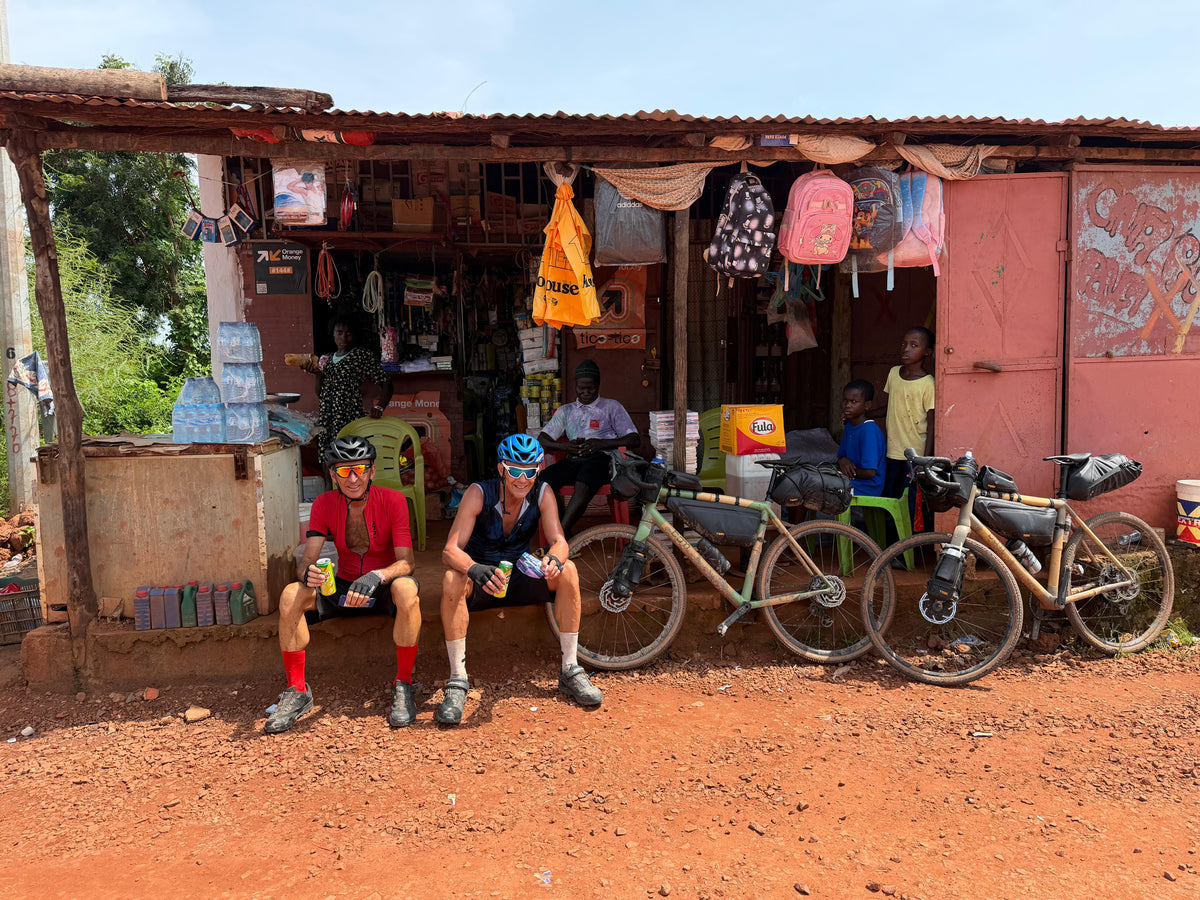
The essential ingredients for an exploratory cycling adventure in Africa are few and simple: a bit of adventurous spirit, the ability to adapt and the right equipment for the conditions you'll encounter along the way. Once you've chosen your bike – for our West Africa Tour, my friends Roberto Cravero and Marco Liprandi and I rode BAM gravel bikes with incredibly lightweight bamboo frames – the most important decision is which bags to take. After all, they need to hold everything you need, making the most of every inch of space without filling them with unnecessary items.

We equipped our bikes with eight bags from the TAAC gravel range, all waterproof, of course:
- Two 2-litre CARGO PAAC bags mounted on the forks, carrying bike spare parts and tools;
- A 10-litre HANDLEBAR ROLLPAAC mounted in front of the handlebars, holding toiletries, medicines, charging cables and plugs, swimwear and a small towel;
- Two SNACK PAAC handlebar bottle holders;
- A TOP TUBE PAAC bag mounted on the top tube of the frame;
- A 4-litre FRAME PAAC bag mounted beneath the top tube, serving as our mobile pantry for nutritional supplements – essential when you never know where or when your next meal will be;
- Finally, a 14-litre SADDLE PAAC, securely positioned behind the saddle, where we squeezed in the very few clothes we brought along for when we weren't cycling.

This year's tour, from Dakar, the capital of Senegal, to Bissau, the capital of Guinea-Bissau, underwent constant changes. After all, one of the best things about this kind of journey is the freedom to improvise along the way.
For us, the priority was always to choose secondary dirt roads, covered in Africa's characteristic red earth: sandy tracks that made us suffer like hell, especially under the scorching tropical sun; singletracks through forests; and vast, semi-desert landscapes with long, deep water crossings where we often ended up unexpectedly submerged, eventually having to wade out on foot, covered in mud.
The road itself was our main stage, with beaches, villages, markets and forests providing the natural backdrop to our little sporting adventure, unfolding day after day through new chapters and stories. Living an experience like this is both rewarding and rejuvenating.

Physically, it can be exhausting – and it certainly was for us – but the emotions that accompanied us throughout the journey, the extraordinary sense of freedom we experienced and the rugged beauty of the ever-changing landscapes around us meant that fatigue remained just a passing sensation.
Mentally, however, a journey like this is incredibly enriching. Meeting people – ordinary people who often don't even understand what you're saying or asking because of language barriers, yet still try to respond or help – adds something truly valuable to an ever-growing collection of travel experiences.

And when setbacks occur, such as mechanical problems with the bikes or difficulties at border crossings, you find ways to overcome them. Before you know it, those problems have turned into wonderful memories to treasure and stories to tell.

